
Adaptive Neural Networks with Reinforcement Learning for Real-Time ECG Diagnosis of Cardiac Arrhythmias
Article Sidebar
Main Article Content
Abstract
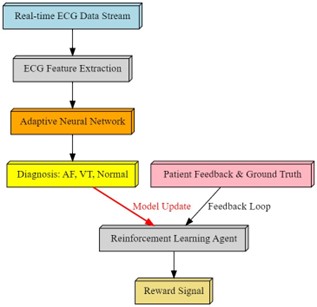
Cardiac arrhythmias, including atrial fibrillation (AF) and ventricular tachycardia (VT), are major causes of mortality worldwide, requiring timely detection for effective treatment. Electrocardiogram (ECG) signals are the primary diagnostic tool for arrhythmias, but existing static models often fail to adapt in real-time to patient-specific data, leading to reduced diagnostic accuracy. This paper proposes an adaptive neural network system integrated with reinforcement learning (RL) for real-time ECG diagnosis. The system continuously updates its model weights in response to new ECG data, allowing it to maintain high diagnostic accuracy even in dynamic clinical environments. By leveraging RL, the model improves both its accuracy and adaptability, addressing limitations of traditional machine learning and deep learning methods. Extensive experimental results show significant improvements in accuracy (up to 94%), precision (91%), recall (90%), and adaptation speed over static models. The proposed adaptive system is highly suitable for continuous patient monitoring, offering real-time performance and potential applications in clinical settings. Limitations regarding data dependency and computational costs are discussed, with recommendations for future research to enhance scalability and efficiency.
Article Details

This work is licensed under a Creative Commons Attribution-NonCommercial 4.0 International License.
IJCERT Policy:
The published work presented in this paper is licensed under the Creative Commons Attribution 4.0 International (CC BY 4.0) license. This means that the content of this paper can be shared, copied, and redistributed in any medium or format, as long as the original author is properly attributed. Additionally, any derivative works based on this paper must also be licensed under the same terms. This licensing agreement allows for broad dissemination and use of the work while maintaining the author's rights and recognition.
By submitting this paper to IJCERT, the author(s) agree to these licensing terms and confirm that the work is original and does not infringe on any third-party copyright or intellectual property rights.




References
] M. Heeringa et al., "Prevalence, incidence and lifetime risk of atrial fibrillation: the Rotterdam study," Eur. Heart J., vol. 27, no. 8, pp. 949–953, 2006.
] P. M. Kearney et al., "Global burden of hypertension: analysis of worldwide data," The Lancet, vol. 365, no. 9455, pp. 217–223, 2005.
] P. de Chazal et al., "Automated processing of ECG signals for the detection of obstructive sleep apnea," IEEE Trans. Biomed. Eng., vol. 50, no. 5, pp. 686–696, 2003.
] S. Osowski, L. T. Hoai, and T. Markiewicz, "Support vector machine-based expert system for reliable heartbeat recognition," IEEE Trans. Biomed. Eng., vol. 51, no. 4, pp. 582–589, 2004.
] G. D. Clifford, F. Azuaje, and P. McSharry, Advanced Methods and Tools for ECG Data Analysis. Norwood, MA: Artech House, 2006.
] Y. Yao et al., "A convolutional neural network approach to detecting atrial fibrillation from single-lead ECG recordings," in Proc. IEEE Int. Conf. Bioinformatics and Biomedicine (BIBM), 2017, pp. 1006–1011.
] P. Rajpurkar et al., "Cardiologist-level arrhythmia detection with convolutional neural networks," Nat. Med., vol. 23, no. 11, pp. 1214–1219, 2017.
] G. Hannun et al., "Cardiologist-level arrhythmia detection and classification in ambulatory electrocardiograms using a deep neural network," Nat. Med., vol. 25, no. 1, pp. 65–69, 2019.
] M. Zihlmann, D. Perekrestenko, and M. Tschannen, "Convolutional recurrent neural networks for electrocardiogram classification," in Proc. 43rd IEEE Int. Conf. Acoustics, Speech, Signal Process. (ICASSP), 2017, pp. 2062–2066.
] R. Acharya et al., "Automated ECG analysis for detection of arrhythmias," J. Med. Syst., vol. 36, no. 1, pp. 15–22, 2012.
] Y. LeCun, Y. Bengio, and G. Hinton, "Deep learning," Nature, vol. 521, no. 7553, pp. 436–444, 2015.
] A. Komorowski, L. Celi, O. Badawi, A. Gordon, and D. Faisal, "The artificial intelligence clinician learns optimal treatment strategies for sepsis in intensive care," Nat. Med., vol. 24, no. 11, pp. 1716–1720, 2018.
] M. Li et al., "Using reinforcement learning for treatment optimization in diabetes," J. Diabetes Sci. Technol., vol. 8, no. 5, pp. 1109–1117, 2014.
] R. Miotto, F. Wang, S. Wang, X. Jiang, and J. T. Dudley, "Deep learning for healthcare: review, opportunities, and challenges," Brief. Bioinform., vol. 19, no. 6, pp. 1236–1246, 2018.
] H. J. Lee et al., "Reinforcement learning-based ECG signal classification for early detection of arrhythmias," IEEE J. Biomed. Health Inform., vol. 25, no. 2, pp. 334–343, 2021.
] P. Liu et al., "Reinforcement learning in medical image analysis: concepts, applications, and opportunities," IEEE Access, vol. 8, pp. 128283–128298, 2020.
] V. Mnih et al., "Human-level control through deep reinforcement learning," Nature, vol. 518, no. 7540, pp. 529–533, 2015.
] D. Silver et al., "Mastering the game of Go with deep neural networks and tree search," Nature, vol. 529, no. 7587, pp. 484–489, 2016.
] J. Schulman et al., "Proximal policy optimization algorithms," arXiv preprint, arXiv:1707.06347, 2017.
] Y. H. Hu et al., "A patient-adaptive ECG beat classifier using dynamic temporal warping," IEEE Trans. Biomed. Eng., vol. 44, no. 6, pp. 559–566, 1997.
] N. Esteva et al., "A deep learning approach for personalized cancer treatment recommendation," IEEE Trans. Med. Imaging, vol. 38, no. 1, pp. 207–215, 2019.
] M. Zihlmann, D. Perekrestenko, and M. Tschannen, "Convolutional recurrent neural networks for electrocardiogram classification," Proc. IEEE ICASSP, 2017, pp. 2062–2066.
] A. L. Goldberger et al., "PhysioBank, PhysioToolkit, and PhysioNet: components of a new research resource for complex physiologic signals," Circulation, vol. 101, no. 23, pp. e215–e220, 2000.
] J. Yoon et al., "An adaptive deep learning approach to ECG signal denoising and arrhythmia classification," IEEE Access, vol. 7, pp. 139471–139481, 2019.